.svg)
.svg)
.svg)
.svg)
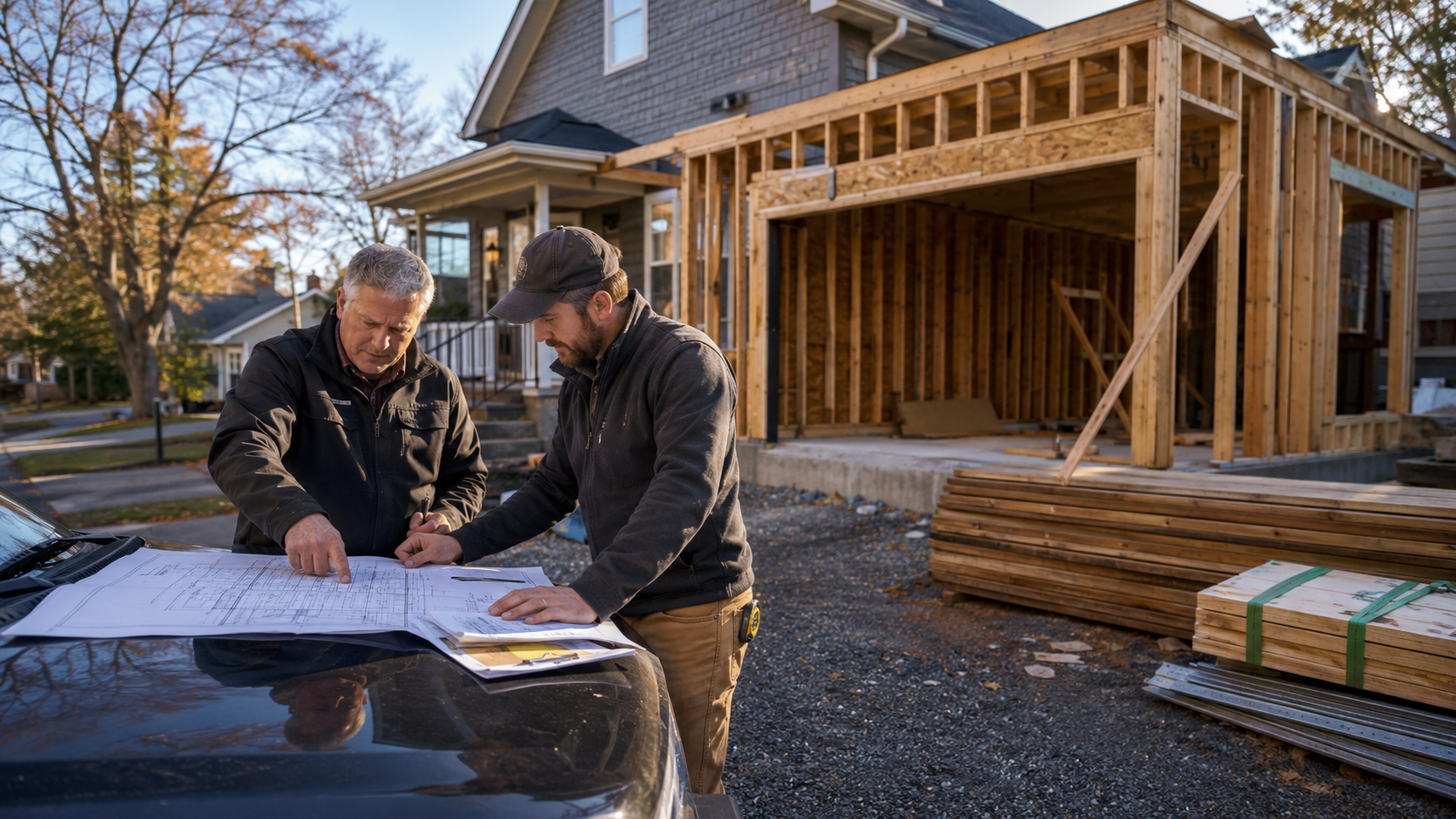
A garage addition is one of the most practical home improvements a Halifax homeowner can make. It protects your vehicles, adds usable storage, increases your property value, and can even create additional living or workspace. But before you move forward, understanding what it actually costs and what drives those costs is essential for planning a project that stays on budget and delivers real returns.
Garage Addition Costs in Halifax: What Homeowners Can Expect
In Halifax, the average cost of a garage addition ranges between $30,000 and $120,000, depending on the type, size, and finish level. A basic single-car attached garage sits at the lower end, while a detached two-car garage with insulation, electrical, and finished interior pushes toward the higher range.
Garage Type
Estimated Cost Range
Single-Car Attached Garage
$30,000 – $55,000
Double-Car Attached Garage
$55,000 – $90,000
Single-Car Detached Garage
$40,000 – $65,000
Double-Car Detached Garage
$65,000 – $120,000
Garage with Living Space Above
$100,000 – $180,000+
These figures cover design, materials, labour, and basic permits but may not include utility connections, lot grading, or premium interior finishes. Understanding these baseline cost ranges gives you a realistic foundation for budgeting your Halifax garage addition and helps you have more informed conversations with your contractor.
Attached vs. Detached Garage Addition Costs
Choosing between an attached and detached garage is one of the first decisions you'll make, and it has a direct impact on your total project cost.
Attached Garages share one or more walls with your existing home, which reduces exterior finishing costs and simplifies heating connections. They offer convenient interior access and tend to cost less per square foot than detached structures. However, they require careful integration with your home's existing roofline and foundation, which can add complexity depending on your property layout.
Detached Garages are standalone structures built separately from the main house. They offer more flexibility in terms of placement on the lot and are easier to design without matching an existing roofline. The trade-off is higher cost, separate foundation, full exterior envelope, and independent utility connections, all add up.
Factor
Attached Garage
Detached Garage
Average Cost
$30,000 – $90,000
$40,000 – $120,000
Design Complexity
Moderate
Lower
Utility Connection
Easier
Separate Run Required
Lot Flexibility
Limited
Higher
Interior Home Access
Direct
No
For most Halifax homeowners with standard lot sizes, an attached garage offers the best value, but a detached structure may be the only viable option depending on your property's layout and zoning setbacks.
Factors That Affect the Cost of a Garage Addition
Several variables shape your final project cost. Understanding each one helps you plan smarter and avoid budget surprises.
Foundation Requirements
The foundation is one of the most significant cost drivers in any garage addition. In Halifax, frost depth requirements mean concrete footings must extend well below grade to prevent frost heave, typically 4 feet or more. Poured concrete slabs with proper drainage, insulated concrete forms, or thickened-edge slabs are all common options. Sloped lots or poor soil conditions can significantly increase excavation and forming costs.
Roof Integration
For attached garages, the new roof must tie seamlessly into the existing home's roofline. Matching pitch, shingles, and fascia details adds both material and labour cost compared to a simple standalone roof on a detached structure. Complex intersecting rooflines or dormers add further cost.
Electrical and Plumbing
A basic garage needs at minimum a subpanel, lighting, and a few outlets. If you're adding an EV charging station, workshop circuits, or a utility sink, electrical and plumbing costs increase accordingly. Running a separate service from the main panel to a detached garage can cost $3,000 to $8,000 on its own depending on the distance and service size required.
Insulation and Interior Finishes
An uninsulated garage costs significantly less to build than one finished for year-round use. If you're planning a heated workshop, home gym, or living space above, proper insulation, vapour barrier, drywall, and flooring add $8,000 to $25,000 depending on size and finish level.
Size and Number of Vehicles
Single-car garages typically measure 12x22 to 14x24 feet. Double-car garages run 20x22 to 24x26 feet. Every additional square foot adds material, labour, and foundation cost, but larger garages also deliver better long-term utility and resale value.
Knowing these key cost drivers before finalizing your garage addition plan helps you make smarter design decisions and avoid the unexpected expenses that push most projects over budget.
Is It More Cost-Effective to Add Onto an Existing Garage or Build New?
If you already have a garage, expanding it is almost always more cost-effective than building a new detached structure from scratch. Extending an existing garage typically costs $15,000 to $45,000, depending on how much space is being added and whether the existing foundation can accommodate the extension.
Building a new detached garage starts at $40,000 for a basic single-car structure and climbs quickly from there.
Expanding your existing garage makes sense when:
- The existing structure is in good condition
- Foundation and framing can support the extension
- You simply need more width or depth
- Matching the existing exterior is straightforward
Building new makes more sense when:
- The existing garage is structurally compromised
- Your lot allows a better placement for a new structure
- You want a fully independent space for a workshop or rental suite above
Getting a structural assessment of your existing garage before committing to an expansion is always money well spent in Halifax's variable soil and climate conditions.
Hidden Costs to Consider Before Starting a Garage Addition
Many homeowners budget for the obvious costs but get caught off guard by the less visible ones. Here's what to watch for:
- Permit Fees: Building permits in HRM typically range from $1,500 to $4,000 for a garage addition
- Lot Grading and Drainage: Redirecting surface water away from the new structure can add $2,000 to $6,000
- Driveway Modifications: Widening or extending your driveway to accommodate the new garage can cost $3,000 to $10,000
- Utility Upgrades: If your home's main electrical panel is near capacity, a panel upgrade may be required before adding a garage subpanel
- Soil Testing: Required on some Halifax properties before foundation work begins
- HOA or Deed Restrictions: Some Halifax neighbourhoods have covenants that affect garage design, size, or exterior materials
Accounting for these hidden costs upfront keeps your garage addition budget accurate and prevents the financial stress that derails many home improvement projects mid-construction.
How a Garage Addition Can Increase Your Home's Value
A well-built garage addition is one of the stronger return-on-investment home improvements available to Halifax homeowners. In the Halifax real estate market, homes with garages consistently command higher sale prices and attract more buyer interest than comparable properties without covered parking.
On average, a garage addition in the Halifax area can recover 60 to 80 percent of its construction cost in added resale value, and in high-demand neighbourhoods, that figure can be even higher.
Beyond resale value, a garage addition delivers ongoing practical benefits:
- Protection from Halifax's harsh winter weather and road salt damage
- Reduced vehicle insurance premiums in some cases
- Additional secure storage that reduces clutter in the main home
- Workshop or hobby space that improves daily quality of life
A garage addition doesn't just add square footage, it adds function, comfort, and measurable market value to your Halifax property.
How Long Does a Garage Addition Project Typically Take?
Knowing the expected timeline helps you plan your garage addition with confidence. While every project is different, most follow a similar sequence from design and permits to final inspection.
Project Phase
Estimated Duration
Design and Planning
2 – 4 weeks
Permit Processing (HRM)
4 – 8 weeks
Site Prep and Foundation
1 – 3 weeks
Framing and Exterior
2 – 4 weeks
Electrical and Mechanical
1 – 2 weeks
Insulation and Finishes
1 – 3 weeks
Final Inspection
1 – 2 weeks
A standard garage addition in Halifax typically takes 3 to 5 months from design to completion. More complex projects, such as garages with living space above or significant site challenges, can extend to 6 to 8 months.
Planning your project with a realistic timeline helps you coordinate parking arrangements, financing, and seasonal scheduling without unnecessary disruption to your daily routine.
Ways to Maximize Your Garage Addition Budget
Getting the most value from your garage addition budget doesn't mean cutting corners, it means making smarter decisions from the start.
- Choose an Attached Design Where Possible: Attached garages cost less per square foot and share structural and utility systems with the existing home
- Build for Future Flexibility: Rough in electrical conduit for an EV charger or future subpanel upgrade, even if you don't need it immediately, it's far cheaper to do during construction
- Match Existing Materials: Using the same siding, roofing, and trim as your existing home reduces material costs and maintains curb appeal
- Right-Size the Footprint: Build the size you actually need. A well-planned single-car garage beats an oversized structure that exceeds your budget
- Get Multiple Detailed Quotes: Compare itemized quotes from at least two to three contractors to understand where costs vary and why
- Time Your Build Strategically: Scheduling construction outside of peak spring and summer seasons can sometimes improve contractor availability and pricing
The right decisions early in your Halifax garage addition project mean better quality, fewer surprises, and more value for every dollar you spend.
Why Homeowners in Halifax Trust Signature Homes for Garage Additions
Halifax homeowners choose us because we deliver quality garage additions on time, on budget, and built to last in Nova Scotia's demanding climate.
- Local Expertise: We understand HRM permit requirements, frost depth standards, and Halifax-specific site conditions that affect every garage project
- Transparent Pricing: Detailed, itemized quotes with no hidden fees or last-minute cost surprises
- Integrated Design-Build Service: One team handles everything from drawings and permits to the final inspection
- Quality Construction: Every ga:rage we build meets or exceeds Nova Scotia Building Code standards for structure, insulation, and weather resistance
- Proven Results: Our garage additions are built to add real, lasting value to Halifax homes
When you work with us, you get a team that treats your project with the same standard of care we'd apply to our own homes.
Final Thoughts
A garage addition is one of the smartest investments a Halifax homeowner can make, delivering vehicle protection, added storage, improved daily convenience, and measurable property value all in one project. With costs ranging from $30,000 for a basic single-car attached garage to $180,000 or more for a fully finished structure with living space above, knowing what drives those numbers puts you in control from day one.
Get your permits in order, work with a builder who knows Halifax inside and out, and invest in quality construction that holds up for years to come.
FAQs
How Much Does A Garage Addition Cost In Halifax?
Costs range from $30,000 for a basic single-car attached garage to $120,000 or more for a fully finished detached two-car garage. Projects with living space above can exceed $180,000, depending on size and finishes.
Do I Need A Permit To Add A Garage In Halifax?
Yes. All garage additions in HRM require a building permit. Depending on the size and location, a development permit may also be required. Permit fees typically range from $1,500 to $4,000.
How Long Does A Garage Addition Take In Halifax?
Most standard garage additions take 3 to 5 months from design to completion. More complex projects can take 6 to 8 months including permit processing.
Is An Attached Or Detached Garage Cheaper To Build?
Attached garages are generally less expensive because they share walls, roof connections, and utility systems with the existing home. Detached garages require independent structural and mechanical systems, which increases overall cost.
Can I Add A Garage To Any Halifax Property?
Most Halifax residential properties can accommodate a garage addition, but setback requirements, lot coverage limits, and zoning rules must be confirmed for your specific property before proceeding.
Does A Garage Addition Add Value To A Halifax Home?
Yes. Garage additions in Halifax typically recover 60 to 80 percent of their construction cost in added resale value. In high-demand neighbourhoods, the return can be even stronger.
Can I Add An Apartment Or Living Space Above My Garage?
Yes, but this significantly increases cost and complexity. A garage with a living suite above typically costs $100,000 to $180,000 and requires additional permits, fire separation requirements, and separate utility considerations.
What Size Garage Should I Build?
A single-car garage typically measures 14x24 feet. A double-car garage runs 24x24 feet or larger. Building slightly larger than your immediate needs provides better long-term utility and resale appeal.
Can I Add An Ev Charging Station To My New Garage?
Absolutely. Roughing in a 240V circuit for an EV charger during construction is far more cost-effective than adding it later. Many Halifax homeowners are including EV-ready electrical in their garage plans as standard.
How Do I Choose The Right Contractor For A Garage Addition In Halifax?
Look for a local contractor with experience in HRM permit processes, verifiable references, and a clear itemized quote. A design-build firm that manages both the design and construction under one team typically delivers the most efficient and cost-effective result.